
Annoying the Neighbours
by John Clarke
The city of Basel in Switzerland has been annoying its neighbours for 500 years.
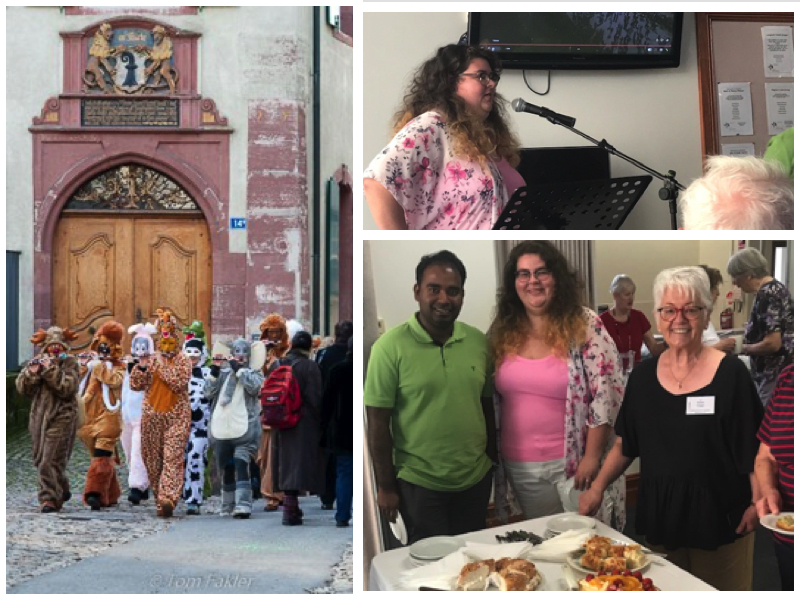
The last meeting of the German speaking group Kaffee und Kuchen took place on Monday, 23 February, the first day of Basel’s annual carnival, known as Fasnacht, and the guest speaker was Basel resident Michèle Rahaman-Monnier and her topic Fasnacht.
Why does Basel’s Fasnacht annoy the neighbours? Before the Reformation in the sixteenth century all cities held their carnival on the same day: the Tuesday before the Christian season of Lent. The word carnival derives from the Medieval Latin words carne levare, which mean leaving off meat. It was the day to celebrate, to eat all the meat, because Lent was a time of fasting (no meat) and sobriety.
The Reformation saw Europe divided into Protestant and Catholic. Basel became a Protestant city, while other cities in Switzerland and over the border in France and Italy were Catholic. Basel moved its carnival from the Tuesday to the following Monday, into Lent, a move which would have outraged the Catholic neighbours. How could they eat and drink and celebrate at such a holy, severe time of year!
Through the wonders of modern technology Michèle was able to connect her audience with Fasnacht. In Basel it was 4 am, the time when the revellers gather. On the screen the audience could see movement in the darkness, and at exactly 4 o’clock lanterns were lit and musicians began to play. There are 20,000 active participants.
To the martial tune of Morgestraich cliques (clubs that had been preparing for months) wound their way in masks and costumes topped with lanterns through the streets and alleys of the city.
The first main parade – there are two – takes place on the Monday afternoon. Each clique, its members now in distinctive uniform and playing piccolos and drums, follows a giant lantern which depicts that clique‘s focus. (Each clique chooses a political or cultural event or person to ridicule. US Presidents have proved popular.) Brass bands feature in the festivities for the first time. And there are floats, called Waage, and from those floats Waagis shower onlookers with huge amounts of confetti, always of one colour. (It has been said that confetti originates in Basel.) By Monday night those attending restaurants and bars, where Schnitzelbank (short rhyming verse) performers sing satirical songs, walk knee deep through confetti. The confetti is always cleared away by morning.
Tuesday is the Kinderfasnacht (children’s carnival), when children and their parents (often in their home-made costumes) hold their own parades. The main concert is on the Tuesday night, and in the centre of the city the major brass bands perform before thousands of onlookers. 200,000 visitors come to Basel for Fasnacht. Other bands perform their Guggemusik at several venues throughout the city.
Another colourful parade takes place on Wednesday afternoon, and then restaurants, bars and beer cellars are packed with merry makers until Ändstraich, at 4 am on Thursday when Fasnacht comes to an end, an end to die drey scheenschte Dääg (the three most beautiful days). Since 2017 the Carnival of Basel has been listed in UNESCO’s Intangible Cultural Heritage.
The next Kaffee und Kuchen meeting will be held at the Langmeil Centre, 7 Maria Street, Tanunda on Monday, 30 March, starting at 1 pm. The guest speaker will be Dr Greg Lockwood.