
Namibia to China and Beyond
By John Clarke
And beyond to Adelaide.
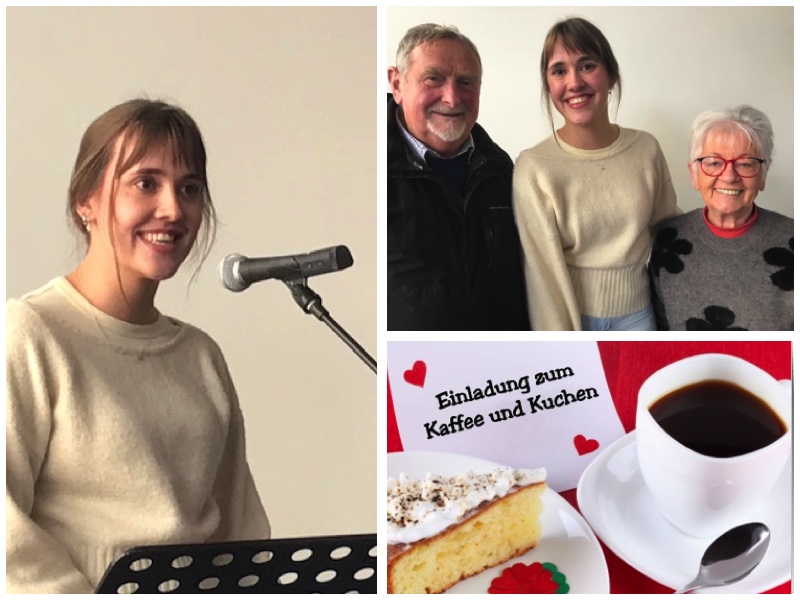
Alina Bergkemper was the guest speaker at the latest meeting of the German speaking group Kaffee und Kuchen. Alina’s educational journey began after she graduated from the University of Bielefeld Langenberg in Germany. A teacher of English and German as a Second or Foreign Language, it was a journey on which she learned as much as she taught.
From 1884 to 1915 Namibia, known then as German South West Africa, was part of the German Empire, and German remains a minority language with 25,000 speaking the language regularly. Rich in minerals, the country suffers from extreme inequality with
many of its people living in poverty. Alina taught in a secondary school, which was under funded, and while the children were happy, their situation was very different from life she had experienced in German schools. That some of the young girls were pregnant did not shock as it would in schools in Europe and Australia.
China was very different. At Hangzhou Alina taught young people between the ages of 11 and 17 at a Goethe Ferien Camp (a holiday camp, organized by the Goethe Institute). ‘Holiday’ seems a misnomer, and although the Goethe Institute was involved, the camp remained very much State controlled. Teachers were directed what to teach and how to teach. While the Namibians had a historic, if uneasy, connection with German, for the Chinese learning German was seen as an opening of business opportunities, an important language of trade. The course was intensive and examination driven.
Alina worked also in online education, providing German classes to students in every habitable continent. Most learned, like the Chinese, to increase their chances in the competitive business world, but there were those wishing to emigrate to countries where
German is the dominant language, and tourism was another consideration. Now in Adelaide, completing her Master’s degree in German as a Foreign Language and German Studies, Alina is working at Adelaide University as an Assistant Lecturer in German.
Why are South Australians learning German? Their motivation may be different. It could be cultural; many have German ancestors. It could be the lure of overseas travel. And then German is the language of Science. And for Classical
musicians Germany and Austria are at the centre of the musical world.
The next Kaffee und Kuchen meeting will be held at the Langmeil Centre, 7 Maria Street,
Tanunda on Monday, 31 August, starting at 1 pm.