
Beginnings from Endings
by John Clarke
When confused and angry men were marched by soldiers with fixed bayonets into a barbed wire compound, it must have felt like the end.
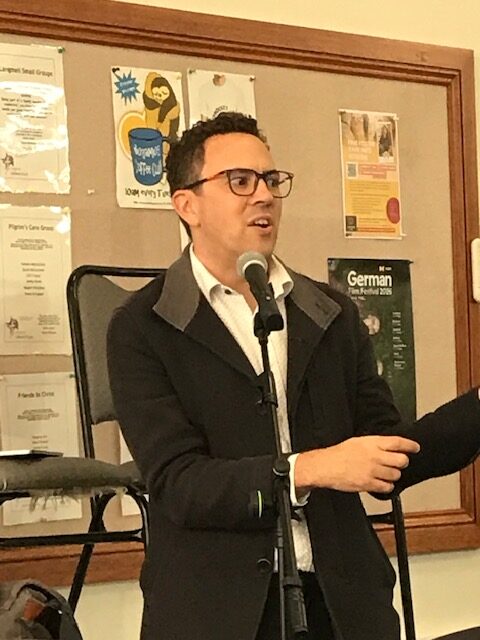
The guest speaker at the last meeting of the German speaking group Kaffee und Kuchen was Dr Aaron Humphrey, lecturer in Media at Adelaide University. His topic was the cartoons and comics produced by two of the internees at the Holsworthy German Concentration Camp during World War I.
A frustrated artist, Kurt Wiese at the insistance of his family had been educated in the export trade and sent to work in China. At the outbreak of war in 1914 he was captured by the Japanese (Britain’s ally at that time), and as an enemy alien he was sent to Australia, eventually ending up in Holsworthy.
The prisoners in Holsworthy were innovative, and despite the cramped conditions, little in the way of amenities, poor food and subject to oppressive heat in summer and freezing cold in winter they created a village atmosphere with shops, theatre and even an outdoor cinema. Such innovation led the authorities to produce the G.C.C. [German Concentration Camp]Album, a piece of propaganda that presented the internment camp as little less than a holiday camp.
The effect was anger among the internees and the launch of their own weekly newspaper Kamp-Spiegel (Camp Mirror). The newspaper contained satirical illustrations by, among others, the aspiring artist Kurt Wiese. The Kamp-Spiegel was published from 1916 to 1917 and then under various other names until the end of the war in 1918.
Kurt Wiese returned briefly to Germany, but not to life as a merchant. In Brazil he set himself up as an illustrator before moving to the United States. There he achieved widespread success as the illustrator of Felix Salten’s children’s book Bambi. Over the next twenty years he went on to win many prestigious awards.
The second talented internee was C Friedrich. Little is known of him; it has even been suggested that his name is a pseudonym, an ironic reference to the German Romantic painter Caspar David Friedrich whose beautiful landscape paintings contrast so markedly to the dusty in summer, boggy in winter concentration camp. While Friedrich contributed to the Kamp-Spiegel, he also produced a series of five books Reise-Abenteuer eines braven Deutschen im Lande der Kangaroo (Voyages and Adventures of a well-behaved German in Kangarooland) which documented his life in the Holsworthy camp, from his arrival still in the smart clothes he had worn aboard ship to an imagined escape four years later.
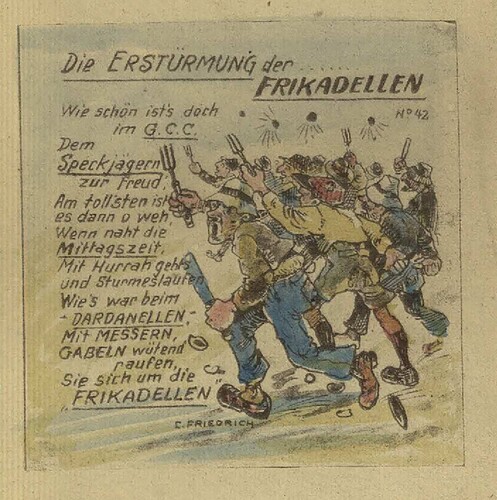
His Reise-Abenteuer consists of over sixty satirical cartoon panels, each with an accompanying rhyming text (probably written by Friedrich). A common motif is the soldier with the fixed bayonet, showing that no matter what activity the internee is following, such as carrying a bench to the open air cinema (in the rain in Friedrich’s cartoon), there is no escaping he is a prisoner. Another motif is the O K food can, a comment on the variety and nutritional value of the food the internees received.
He did not achieve fame as Wiese did, but with his five books he introduced a genre of literary art: the autobiographical cartoon. It was the beginning of a form of graphic writing which would grow and continue to grow over the next one hundred years.
The next Kaffee und Kuchen meeting will be held at the Langmeil Centre, 7 Maria Street, Tanunda on Monday, 29 June at 1 pm. It will be preceded by a German luncheon of goulash, red cabbage and spaetzle at 12 noon. The cost of $28 per person includes coffee and cake at the end of the meeting. Those wishing to attend must contact Steffi Traeger (0408 621 384; stefnbobb@bigpond.com) by Monday, 22 June.