
It’s No Picnic
by John Clarke
While on an outing with her children Marlene Thurlow’s grandmother was asked: “Are they all yours, or are you on a picnic?” To which Mrs Modra replied: “They’re all mine, and believe me, it’s no picnic.”
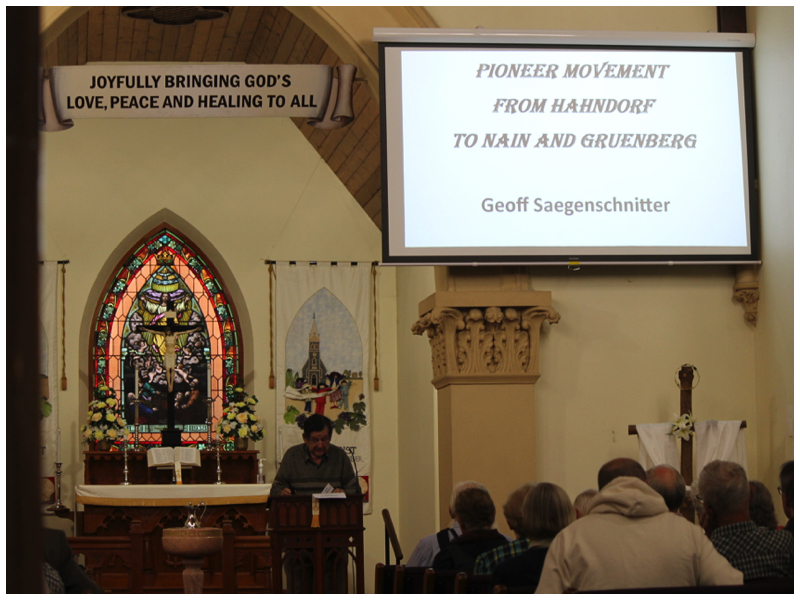
Marlene was one of the speakers at the History Festival Seminar Day, held at the Langmeil Centre, Tanunda, the theme of which was Moving On: Mapping German Settlement Trails. Her grandmother’s response could well have been a repeated refrain.
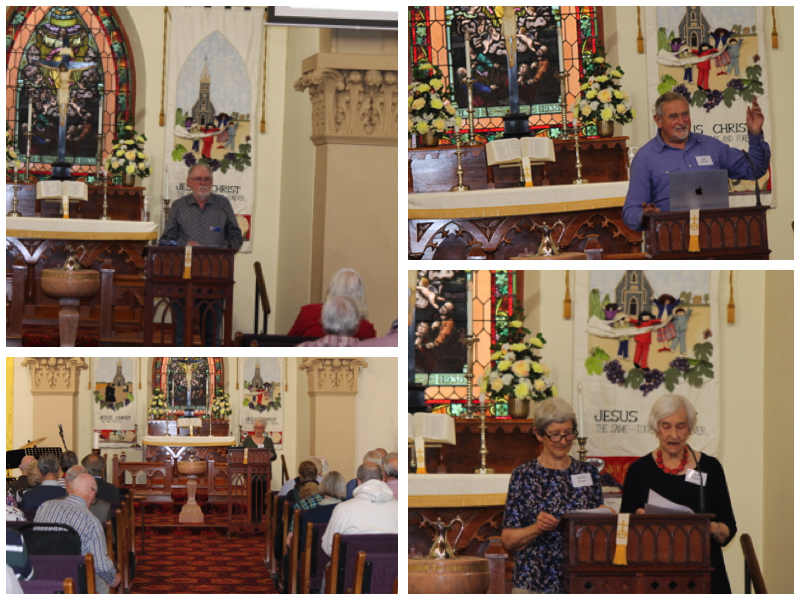
below: Steffi Traeger, Pauline Burger and Ruth Walter
Moving on was not simple, it was not easy, and often it was not a matter of choice. The first German settlements in South Australia were at Hahndorf and Klemzig, but as the numbers of immigrants grew, more land was needed. Extravagant descriptions of land beyond the Adelaide Hills were designed to attract the purchase of land. Was Tanunda Creek a navigable river which would allow the transport of goods to and from Adelaide?
Settlements began in what was known as New Silesia, first at Hoffnungstal and Bethany and then spreading through today’s Barossa Valley. Large families needed extensive properties, but the desire to own land was not the only motivation to move on. Some of their problems were of their own making. Lutheran congregations split and refused to worship together; they wanted their own communities. And the Wendish people felt uncomfortable living with the Old Lutherans and created their own centres of work and worship at Rosenthal, Ebenezer and Peters Hill.
And as time passed, more land was required. In 1865, after travelling 3,200 kilometres on horseback and observing the vegetation, George Goyder, South Australia’s Surveyor-General, drew a line on the map (known as Goyder’s Line) and declared the land beyond that line was suitable only for light grazing. His opinion was ignored, and many farmers took up land beyond the Line. After a couple of good seasons drought returned and forced many back south and east to Eyre Peninsula.
Hardship was not only felt by the farmers. Those who served the communities also suffered. Again and again the speakers at the Seminar Day spoke of rough and dangerous paths through the bush, furrowed dirt roads, long journeys by foot. Eduard Meyer was pastor of the Lutheran church in Bethany, but as settlements sprang up in the Barossa Valley and on its fringes, he found himself the pastor of a dozen more, often quite small, villages. Many days were spent travelling from one to the next.
And the villages required teachers. Pastor Meyer appointed Teacher Ploennies to the school at Peters Hill. The Elder of the congregation had agreed to care for him and meet his needs, but it was not long before a stream of letters of complaint were reaching Pastor Meyer. The Elder’s son, who was to clean Ploennies’ room, had left home, and there was no replacement. The Elder’s wife was charging an exorbitant amount for the meals she was providing, and when another provider was found, her charge was even more exorbitant. And after the Sunday service the young people were invading his room and lounging about and smoking their pipes.
The South Australian railway network opened up the Mid North, connecting towns with each other and with Adelaide. Rudolph Sulzmann was stationmaster at Crystal Brook, Jamestown (the first stationmaster), Morgan, Hamley Bridge, Tarlee and Terowie. Through the railway life was made easier for the townspeople and those in neighbouring districts. The stationmaster would make sure that goods would arrive safely and produce would be transported to the city. Apart from frequent moves from place to place the stationmaster had other stresses. He was often the first on the scene at accidents. Rudolph Sulzmann had to give evidence at the inquest into the death of eight year old William Irving. The verdict was: “That deceased lost his way whilst out rabbiting, and becoming weary lay down between the rails, and was accidently killed by a passing train.”
So whether those Germans found their way to Nain or Krondorf, Peters Hill or Point Pass, or further to Mt Mary or Yeelana on the West Coast (home of the Modra family for 100 years), they would have agreed it was “no picnic.”