Is it in the Blood?
by John Clarke
While through our lives we study and experience so many things, of our personality and our interests how much derives from our ancestors?
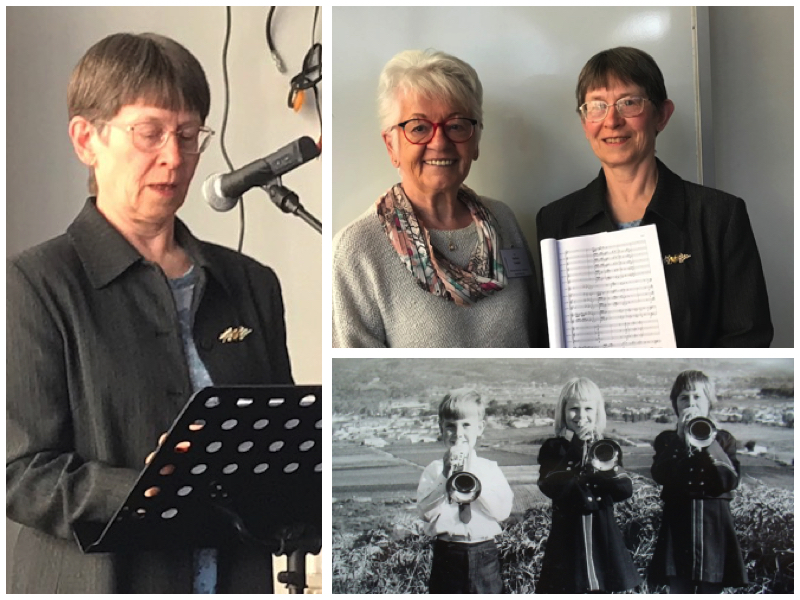
At the last meeting of the German speaking group Kaffee und Kuchen the guest speaker was Shelley Spencer. From a very young age she wanted to compose brass band music. Was that because she was born in the Barossa Valley where brass band music had
become the traditional form of music, and to be a musician meant being a member of a brass band?
Or was the influence deep in the past, among her German ancestors? Her maternal grandmother was a Mattiske. The Mattiske pioneers emigrated to Australia in 1849 and settled at Kingsford, off Gomersal Road. They helped build the church at Rosental (today Rosedale) and played the church organ. F W Mattiske was a member of the Rosental Brass Band. Walter Mattiske, Shelley’s mother’s uncle, belonged to the Army Band and served with the AIF in France.
Shelley, her sister and brother learnt the cornet from a very young age and competed regularly in Tanunda’s annual band championship. “Do you remember the brass bands and the marching girls marching down the main street in the 1970s?” she asked. But Shelley wanted to do more than play. She wanted to compose.
There was no course in Australia, and so she decided the first step was to become a brass band conductor. An early conducting role was with the Campbelltown City Band in 1982. But knowing how to arrange music and conduct was not enough. And so Shelley enlisted in the New Zealand Army. The New Zealand Army Band was at that time the only professional brass band in the world, and there was her opportunity to learn brass band composition. She was accepted into Otago University to study brass
band composing, and there a suggestion from her professor determined the direction her composing career would take. “Draw on your heritage,” he told her.
The homeland of the Wends, or Sorbs as they are known in Germany, is in northeastern Germany. It is from there that Shelley’s maternal father’s family came in 1860. An oppressed people over generations, their music is full of feeling, sad but passionate, and it is that feeling that Shelley drew on when composing music for A Wendish Prayer. (The prayer “Ufer der Hoffnung” (Shore of Hope) was written in the nineteenth century as the Wendish community prepared to emigrate to Australia.)
A Wendish Prayer was Shelley’s entry in an international composing competition in the category of sacred music for brass band. “My composition,” she said, “begins as an intense prayer of supplication, in melancholic, impassioned Wendish style. It later transitions into a humble hymn of praise… The final sections have a folksong feel, symbolising the strong Wendish folk culture, with all voices singing various countermelodies of praise.” The judges awarded A Wendish Prayer third prize.
Drawing on her German Lutheran ancestry, Shelley produced her Reformation Oratorio, inspired by the life of Martin Luther, which was performed at the Langbein Theatre in Tanunda in 2017. She continues to play cornet in the Tanunda Town Band, and the desire to compose has not waned.
She began her talk by playing a recording of an excerpt from her test piece for brass band Saul (which was awarded second place) and finished with a video of the South Brisbane Federal Band performing A Wendish Prayer.
The next meeting of Kaffee und Kuchen will be at the Langmeil Centre, 7 Maria Street, Tanunda on Monday, 26 October, starting at 1 pm. It will be preceded by the Annual General Meeting of the Barossa German Language Association.