Bring Me little Water, Silvy
by John Clarke
Huddie ‘Lead Belly’ Ledbetter collected/wrote and performed Bring Me little Water, Silvy in the early twentieth century. He said it was the cry his uncle made while working in the plantation to his aunt, asking for water to slake his thirst.
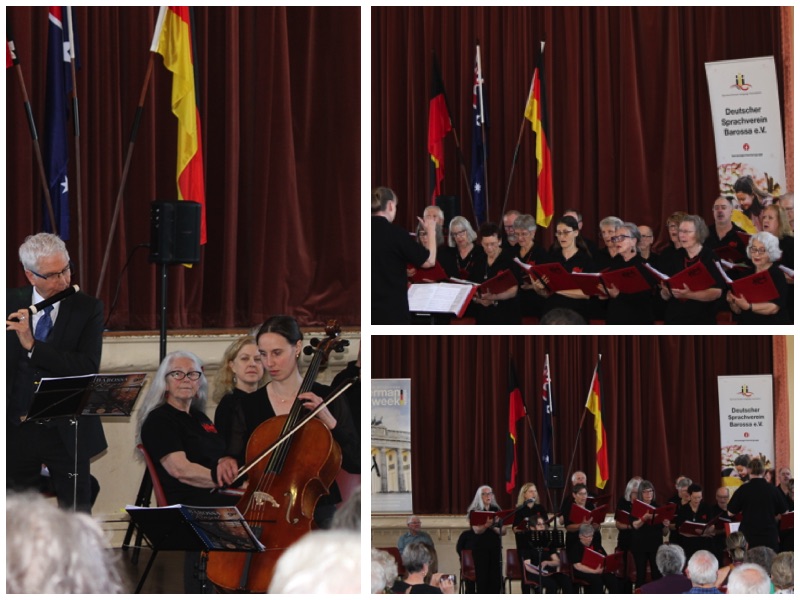
This year the Barossa German Language Association’s contribution to Adelaide German Week was a concert at the Nuriootpa Soldiers’ Memorial Hall. Barossa Konzert 2026, subsidized by the The Barossa Council, featured local talent: the Barossa Trio – Sarah Afshin Pour (piano), Greg Pfeiffer (baroque flute) and Shae Heinrich (cello) – and the Kapunda based KaDenCe Choir. And it provided a musical feast, far more sustaining than the water Silvy brought her husband.
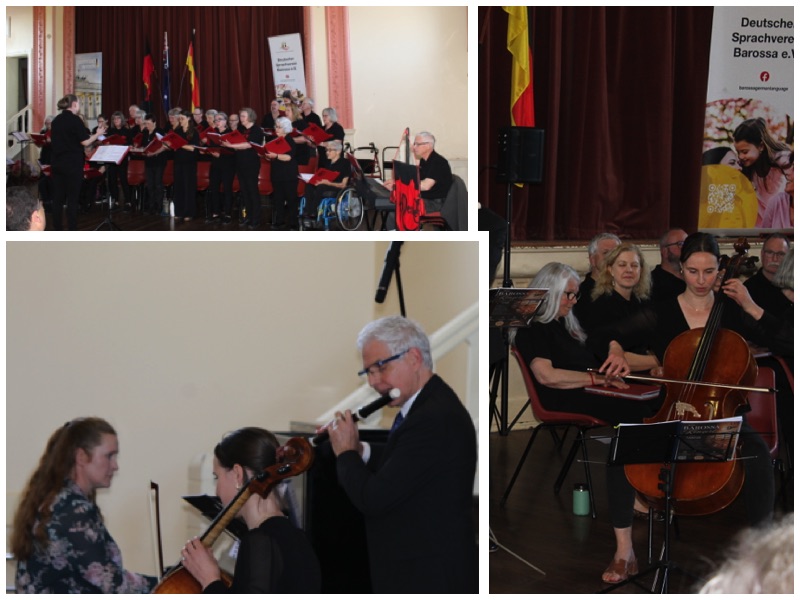
KaDenCe Choir, conducted by Elizabeth Fahlbusch and accompanied by David Garwood and Kate Goodes, provided a wide ranging programme (including Bring Me little Water, Silvy) from Mozart’s Ave Verum to For Good (from the musical Wicked). The contrast and scope were brought out most noticeably in their last two items – a very boisterous, and very popular, compilation of Neil Diamond songs Best of Neil Diamond (Medley) and the peaceful, moving Psalm 23 (The Lord is My Shepherd).
The Barossa Trio, who last year took a geographical journey through the home towns of German speaking composers, kept with the German theme, presenting works in chronological order, starting with Georg Philipp Telemann and finishing appropriately
with Franz Schubert’s Schwanengesang (Swan song). Especially moving was Robert Schumann’s melodious Träumerei (Dreaming) from his Kinderszenen (Scenes of Children).
Both KaDenCe and the Barossa Trio provided commentary on their choices. Schumann told his wife Clara that he had written his Kinderszenen, comprising “thirty small, droll things”, because she said that sometimes he seemed like a child. (What husband has not been told that?)
The Barossa Trio also performed works by Mozart and Johann Christian Bach, an interesting combination as the audience was informed that when Mozart and his family visited England, Mozart and Bach performed for Queen Charlotte, the wife of King
George III, the eight year old Mozart sitting on Bach’s knee and together playing alternate bars of the chosen piece of music.
The programmes of KaDenCe and the Barossa Trio complemented each other well, and it was fitting they should come together with Sarah Afshin Pour’s accompanying KaDenC’s soloist Annaliese Nitschke’s performance of Franz Schubert’s Du bist die Ruh (You are the Rest).
The feast continued after the performance with the best of local produce: Langmeil wine, Barossa Valley Cheese Co cheeses and Gully Gardens dried fruit.